
TECHNOLOGY TRIUMPHANT


Celsus de re medicina (1497) Both paper and print remain perfect.
On May 26 the Wall Street Journal reported that Nvidia was on the verge of joining the likes of Microsoft, Apple, and Alphabet as a $1 trillion company because of the furor set off by Chat GPT and a bevy of other artificial intelligence companies. Nvidia does not do artificial intelligence. The company mostly made chips that powered computer games until those chips turned out to be uniquely suited to generative AI.[1] The company’s value has exploded because it has a key piece of technology.
Something similar happened when Johann Gensfleisch (whom we know as Johannes Gutenberg) made a better moveable type and put it together with other technology that already existed in the middle of the fifteenth century. His printed books were the first identically mass produced items, and language was mechanized. To understand how that happened, we need to start with a bit of history.
It is generally accepted that Gutenberg’s 1454 Bible was the first book printed with moveable type and that the Mainz goldsmith was uniquely responsible for the technology behind it. Both are untrue.
The oldest known printed book currently resides in the British Museum. It is a Buddhist scroll printed from wood blocks in 868 CE. Xylography, another name for reproducing images with carved stamps, spread through most of East Asia long before Gutenberg. The Haein Temple in South Korea has 81,258 wood blocks used to print versions of the Buddhist Tripitaka between 1236 and 1251. Asia had more than xylography; in 1377 a Korean anthology of Buddhist teachings was printed with metal moveable type.
In spite of that, printing never became an industry in the Far East. Part of the failure was due to strict control of a process governments considered dangerous, but it was also the result of the Asian script and the attitude about writing. In the first place tens of thousands of Chinese ideograms made moveable type a formidable undertaking, but the fact that hand drawn calligraphy was seen as an essential fine art was at least as important. How a manuscript was drawn was at least as important as what it said, so printing was left to the Europeans.
Four bits of technology were necessary for the printing press to work—paper, ink, moveable type, and the press itself. We can start with paper. Had the Gutenberg Bible been printed on vellum as most manuscripts had been, it would have required 15,000 skins to produce one edition of 100 volumes. That was obviously impractical.
Paper had been used in China for an astonishingly long time. Chinese tradition holds that Han Dynasty official Cai Lun (ca. 50-120 CE) invented paper making after watching wasps build their nests. He was said to have pounded the inner bark of the mulberry tree mixed with hemp fibers to make a paste that could be dried in sheets. In fact, fragments of ancient paper made from hemp have been found in a tomb near what is now Xi’an, although they were blank and probably used for wrapping rather than writing.
Paper was brought to Europe by Arab traders, and by 1268 paper was being made in Umbria. A number of Italian mills followed soon after. In 14th century Genoa paper was used by notaries, although more important documents such as royal charters and government decrees continued to be written on more durable parchment. Paper making spread with the cultivation of flax and linen. By the mid-1400s, there were paper mills in France, Germany, the Low Countries, Vienna, Cracow, Copenhagen, and Buda. By the 16th century, mills in France alone were turning out 450,000-900,000 reams of paper a year and paper makers became rich.
Between the 14th and 17th centuries, the paper making process hardly changed at all. Rags were collected by specialized dealers and delivered to water-driven mills, often converted from grain processing. The rags were pounded by water-driven mallets studded with nails or small knives. The resulting pulp was suspended in warm soapy water to make a paste and laid on a wire frame to drain. After an initial drying, the paper was put on felt to draw out the last water, pressed several times, and hung to dry. Next it was coated with sizing to make it less absorbent when ink was applied before a final polishing with flint. Finally, the sheets were collected in 25-sheet reams that were bound in 50-ream bales for delivery to market.
The whole process was water intensive. A typical mill consumed 700 liters of water/hour/kilogram of paper. The water had to be fast running to drive the mill and almost perfectly clear to keep from staining the paper. Good quality cloth was needed as well, and white linen underwear was preferred although, as printing spread, rag shortage became a chronic problem.[2] There is a certain irony in the fact that the spread of knowledge was reliant on used undergarments. Mills first tried making thinner paper, and then printers made smaller books to preserve the precious fiber. Two pages printed on each side and folded in half made four pages a sheet, a folio. The number of pages steadily increased to four a side (octavo), then twelve (duodecimo) and sixteen (sextodecimo). Readers complained about the shrinking size and printers about the decline in paper quality. By the 17th century regulations that sound like current computer chip restrictions limited paper export or banned it outright. Countries that had imported paper were forced to build their own mills.
Ink was less of a problem. The water-based ink used on vellum manuscripts did not penetrate paper well and did not stay on the fonts. Although we have no samples of Gutenberg’s ink except what is left on the printed pages, it is clear the early printers quickly developed a thicker, oily black paste that stayed on the letters and permeated the paper sheets. Red cinnabar was used to “rubricate” initial letters of pages and paragraphs.
The fonts were more challenging. Wooden and clay fonts had been invented in Asia, and King Sejong of Korea had even ordered 100,000 sorts (individual characters) to be made of copper in 1403, but it took the metallurgic knowledge of European goldsmiths to perfect the process.
A font (or fount) is a collection of all the characters needed to reproduce a language and includes lower and upper case letters, punctuation, symbols, and numbers. The first fonts were made to look as much like hand drawn manuscript letters as possible although there was no standard size for fonts until the 18th century when a “point” was defined as 1/144 the size of the French king’s foot. First, each character is carved in reverse onto a hard metal—originally brass or bronze and later steel. This “punch” is then hammered into a softer metal—usually copper—to make a mold. Then a third metal—typically a mixture of lead, tin, and antimony—that melted at a lower temperature than the copper was poured in the mold.[3] The result was thousands of copies of the meticulously carved punch. The individual characters or sorts were filed as closely as possible to the same height so they would all strike the paper when mounted in the frame for pressing.
A printer would typically own 60-100,000 sorts which allowed him to set up a few dozen pages after which the letters were retrieved for the next few pages. A single page of a folio Bible in the 16th century would have required 5,000 sorts (10,000 to do both the front and back of a page), and, if all the pages of the 1,000-page Bible had been kept and stored, it would have required 15 square meters of storage space and would have weighed more than 2.5 tons.
Before we get on to the press, a word about how the type was set. The compositor sat on an uncomfortable stool at a slightly tilted desk in front of a cabinet with rows of pigeon holes, each of which contained copies of one sort—small letters in the lower case and capitals in the upper case. At first every printer had his own arrangement of the sorts, although the layout was eventually standardized so compositors could go from shop to shop. Eventually the bottom of each sort was notched so the compositor who knew where each letter was stored could pick up what was needed and put it in the slot of a composing stick in the correct orientation without looking, much the way a typist uses a keyboard. When the line on the composing stick was complete, it was placed in a tray—the galley—and a lead spacer was placed below it to keep sequential lines separate. When the page was complete, the lines were secured in the galley and the whole thing was ready for the press. In a typical twelve to sixteen hour day a good compositor was said to be able to turn out 2,500-3,000 pages. One can imagine a hunched compositor never looking at his flying hands as they filled the sticks and lined them up in a galley. It was the first repetitive manual manufacturing task and remained essentially unchanged until mechanical typesetting was introduced in 1889.
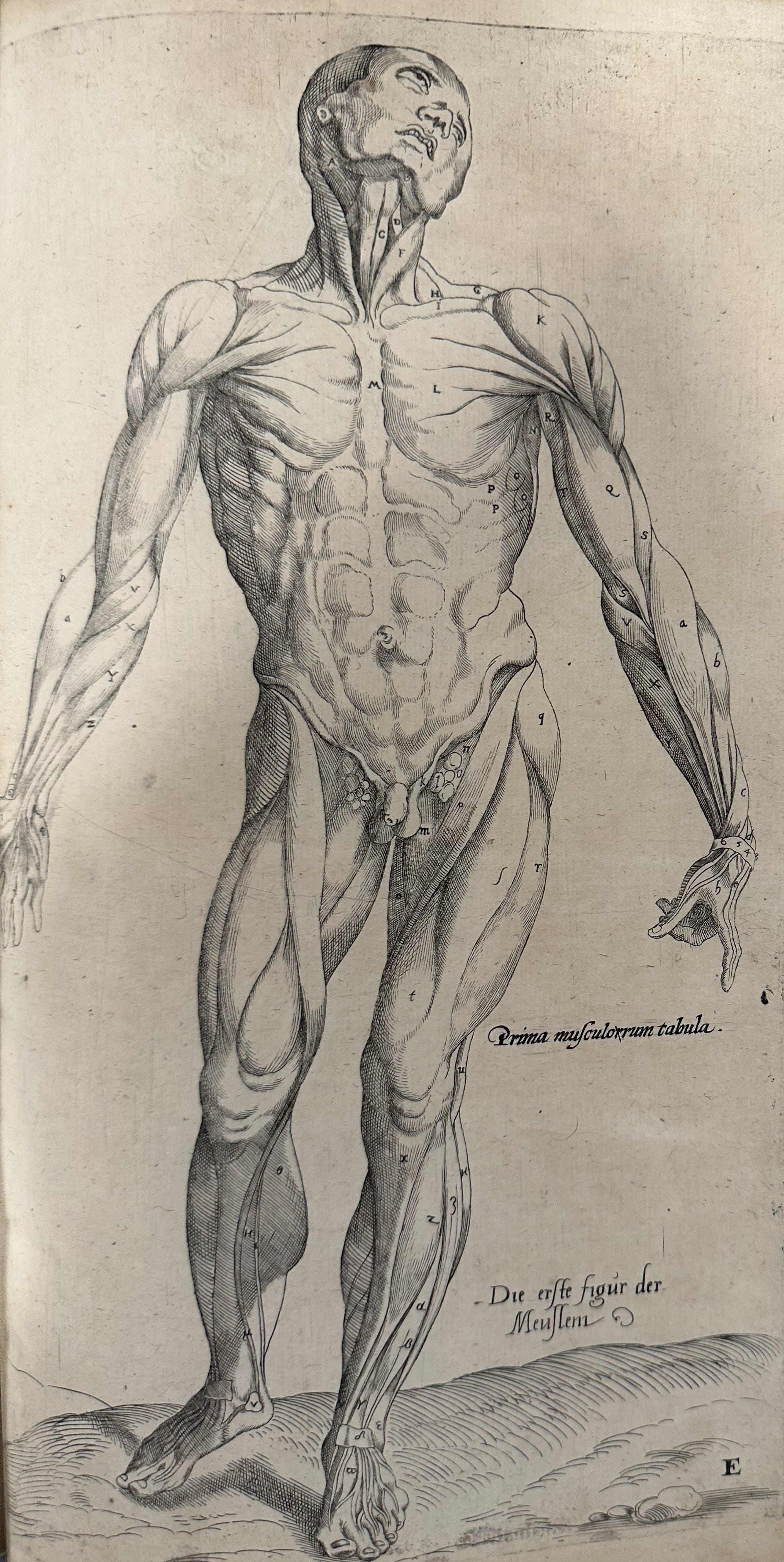
Printing was really two separate inventions—typography for text and block printing or engraving for images. Xylographic prints had been common in Europe since the end of the 14th century, and it was not a great leap to figure out how to use engraved blocks to insert images into printed pages, especially those made perfectly flat by a press. Illustrations first appeared in a printed book only seven years after Gutenberg’s Bible. Religious images were followed by illustrated posters and then playing cards and calendars, and science turned to pictures shortly after that. Jesuit scholar Walter Ong said printing with illustration made quantification of knowledge possible. Exquisite illustrations could be reproduced exactly as they were drawn. Maps and books on zoology, botany, and metallurgy were published in the first hundred years, but perhaps the most stunning was Vesalius’s De humani corporis fabrica libri septem illustrated by Titian’s pupil Jan Steven van Calcar. For the first time physicians and artists could see the interior of the human body as it actually is.

We have neither the plans nor a picture of Gutenberg’s press, but it was probably much like the ones in use for the first three and a half centuries of printing and was directly modeled on wine presses. The galleys were secured in a hinged wooden frame—the forme—mounted on a cart on rails since there was not room to ink the page under the press. The forme also had paper flaps around the edges so only the part of the sheet to be printed was exposed to ink and the margins could be kept clean. Once the forme was closed, the letters were inked and the paper was laid across them. The dolly with the prepared forme was cranked over a marble bed covered with a layer of felt or sheets of paper that allowed the sorts to give a little in case they were not exactly the same height. The platen was then screwed down on the page. The whole device was relatively simple and could be reproduced by any skilled carpenter, so presses multiplied across Europe. The process remained essentially the same until 1814 when the Times of London used the first mechanical press to crank out 1,100 sheets an hour.
If an average print run was 500 copies (a conservative estimate), based on the 30-50,000 editions of books known to have been printed between 1454 and 1501, about 20 million books were produced in the first half century after Gutenberg’s Bible. In the next hundred years, another 150-200 million were printed on a continent with a population of only 20 million, most of whom could not read. The economics were revolutionary. In 1483 a print shop in Florence run by nuns from the Convent of San Jacopodi Ripoli sold 1,025 copies of Plato’s Dialogues for three florins. A scribe would have charged one florin for a single hand copied version of the same book.
Those four bits of technology changed how information was transmitted in a stunningly short period. On March 12, 1455, Eneo Sylvio Piccolomini wrote the future Pope Pius II: “What was written to me about that marvelous man seen at Frankfurt is entirely true. I have not seen complete Bibles but only a number of quires of various books. The script is extremely neat and legible, not at all difficult to follow. You would be able to read it without effort, an indeed without glasses.”[4] Mainz managed to keep the details of Gutenberg’s press a trade secret until the city was sacked in 1462. Refugee printers scattered the technology to Ulm, Basel, Venice, and Rome. In a decade, there were presses all over Europe.
We left off earlier without finishing the story of that “marvelous man.” Gutenberg borrowed 500 florins at 5 per cent interest and then 300 more from Johann Fust to cover the formidable cost of his press, paper, and fonts. He had made some money printing indulgences and short tracts, but they did not nearly cover his expenses and he was unable to pay back either principal or interest on the money he borrowed. Fust and the calligrapher Peter Schoeffer took over the press, which Schoeffer successfully ran well into the 16th century. Gutenberg dropped from view. He was ennobled by the Elector of Mainz in 1465 but remained poor, and no book with his name on it was ever published. So it goes with inventors and investors.
As is almost always the case with “inventions”, printing was an ingenious combination of technologies that mostly existed to fill a need almost no one knew they had. The process was perfected and the product became indispensable. The way knowledge spread and the way the brain worked abruptly and irrevocably changed. We are living in a similar time.
References:
Chappell, Warren, A Short History of the Printed Word. Boston: Nonpareil Books, 1970.
Eisenstein, Elizabeth, The Printing Revolution in Early Modern Europe. Cambridge: Cambridge University Press, 1983.
Febvre, Lucien and Henri-Jean Martin, The Coming of the Book: The Impact of Printing, 1450-1800. London: Verso, 1976. The standard reference.
McLuhan, Marshall, The Gutenberg Galaxy. Toronto: University of Toronto Press, 1962. Third Edition 2011.
Raven, James, ed., The Oxford Illustrated History of the Book. Oxford: Oxford University Press, 2020. The best current summary by multiple authors.
[1] The chips also found a niche in bitcoin mining although that market has been unstable recently.
[2] Wood fiber paper did not become available until the 1840s.
[3] Lead poisoning was a common occupational hazard in print shops.
[4] Martin Davies, trans. “Juan de Carvajal and Early Printing” The Library 18:3 (1996) 196.